Lee Jae-yong leads memorial tribute as Samsung highlights late chairman's contributions to chips and culture
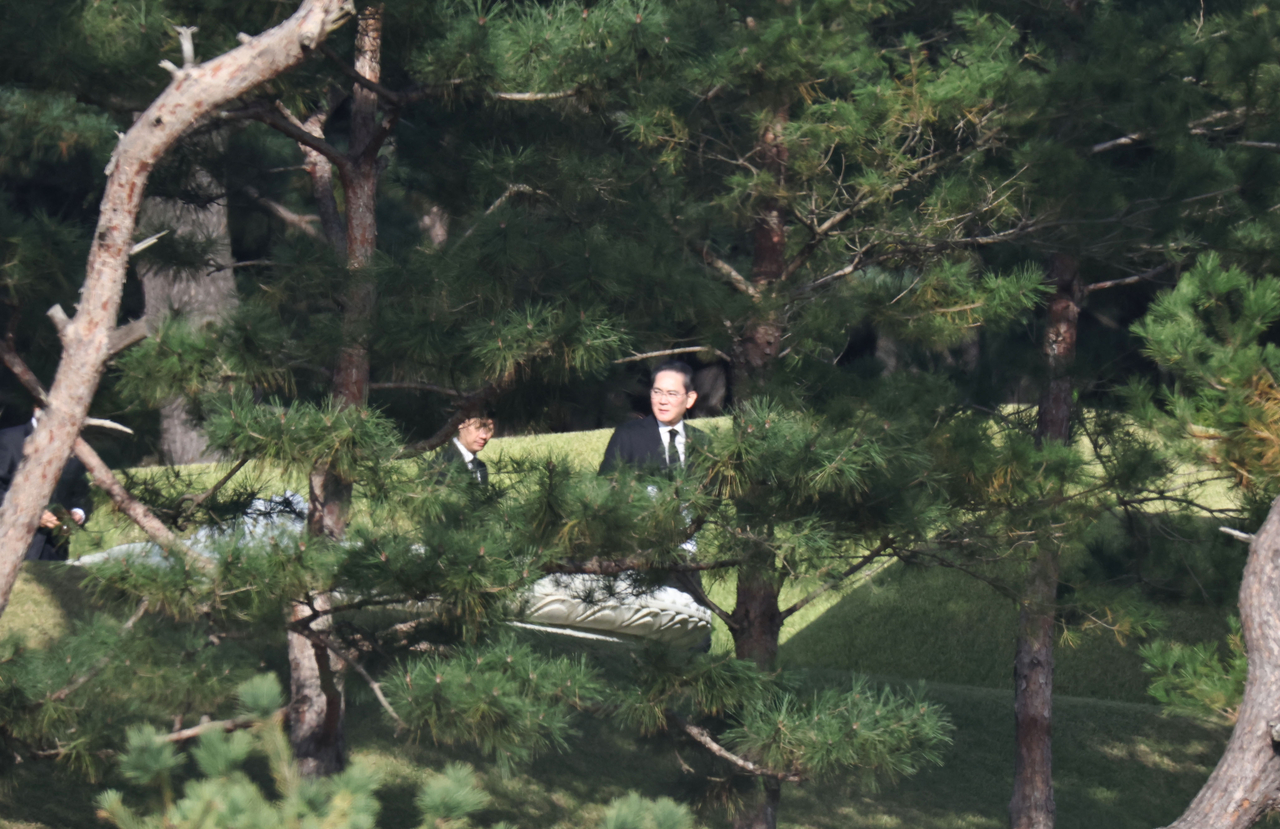
Samsung Electronics Chairman Lee Jae-yong joined senior executives Friday at a memorial service for his late father, former Samsung Chairman Lee Kun-hee, ahead of the sixth anniversary of his death on Sunday.
Lee arrived at the family burial site in Suwon, Gyeonggi Province, at around 8:40 a.m., shortly after returning from a business trip to the United Arab Emirates. He paid his respects at the grave, bowing twice before observing a moment of silence and performing a traditional memorial ritual.
About 50 current Samsung executives arrived shortly after 9:30 a.m., including Samsung Electronics co-CEOs Jun Young-hyun, vice chairman and head of the Device Solutions division, and Roh Tae-moon, president and head of the Device eXperience division.
Around 100 former executives were expected to visit the burial site later in the day.
Other family members, including Lee's mother Hong Ra-hee, honorary director of the Leeum Museum of Art, and his sisters Lee Boo-jin, president of Hotel Shilla, and Lee Seo-hyun, president of Samsung C&T, were also expected to attend.
Following the ceremony, Lee and the executives were scheduled to gather for lunch at Samsung's Human Resources Development Center in Yongin, Gyeonggi Province.
Attention is focused on whether Lee will deliver a message to executives as Samsung navigates intensifying competition in advanced semiconductors and uncertainty in global markets.
At the 2022 memorial gathering, Lee, then vice chairman, urged executives to take bolder action and prepare for future challenges, stressing the importance of strengthening the company's capabilities during difficult times.
Samsung is also scheduled to hold a memorial concert Wednesday at its Human Resources Development Center, featuring performances by internationally renowned musicians. Members of the founding family and senior executives are expected to attend.
From semiconductors to global expansion
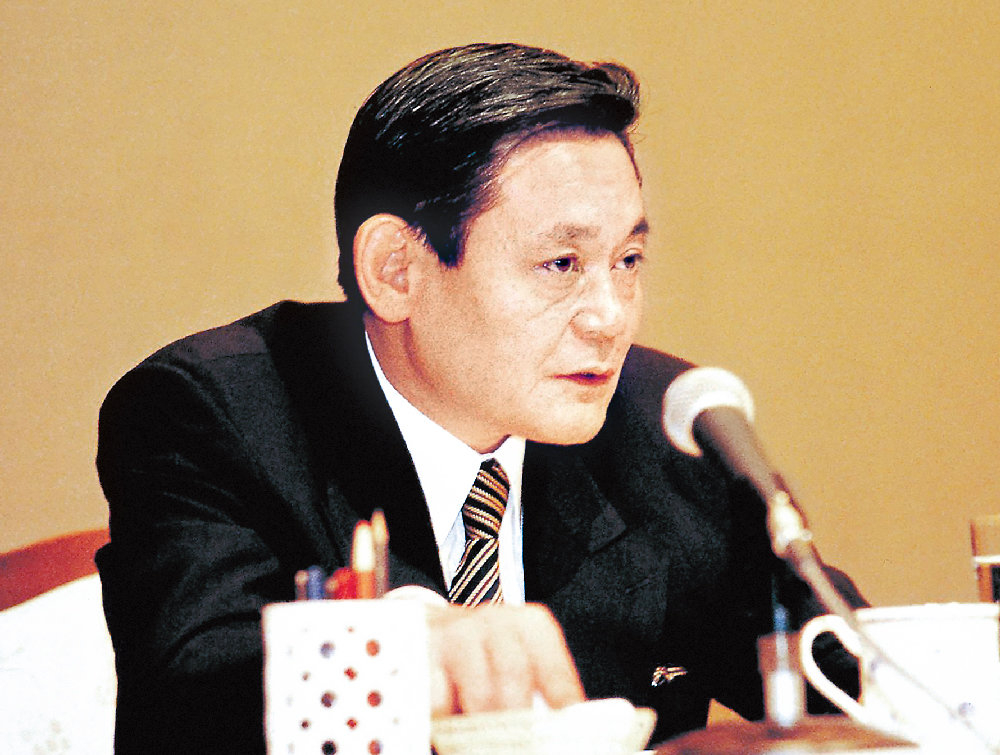
Lee Kun-hee, who died on Oct. 25, 2020, at age 78, is widely credited with transforming Samsung from a domestic conglomerate into a global technology company.
In materials released Friday to mark the anniversary, Samsung highlighted his early semiconductor investments, management reforms and contributions to cultural preservation.
His involvement in chips began in 1974, when he invested personal funds in the struggling Korea Semiconductor. Samsung formally entered the memory chip business in 1983 under founder Lee Byung-chul.
The company developed the world's first 64-megabit DRAM in 1992 and became the global memory chip market leader in 1993.
According to Samsung, Lee's strategy emphasized aggressive investment during industry downturns, helping the company build manufacturing scale and technological capabilities ahead of competitors.
His 1993 New Management initiative, launched in Frankfurt, Germany, marked another turning point. His famous instruction to "change everything except your wife and children" symbolized a shift from production volume toward quality and global competitiveness.
Samsung also credited Lee with emphasizing talent development and anticipating the convergence of semiconductors, software and robotics, technologies increasingly central to today's artificial intelligence industry.
Beyond business, Lee assembled an extensive art collection that his family donated to public museums following his death.
The approximately 23,000 artworks and cultural artifacts include Korean masterpieces and works by international artists such as Claude Monet and Pablo Picasso.
According to Samsung, exhibitions of the Lee Kun-hee Collection have attracted more than 3.5 million visitors across Korea.
Following exhibitions in Washington and Chicago, selected works are now on display at the British Museum in London, where an exhibition featuring roughly 2,000 years of Korean art opened on Oct. 1.
herim@heraldcorp.com